Unstructured Outdoor Play: Imagination, Growth, and Sensory Exploration
By Jessica Jordan, MS. OTR/L
Why Outdoor Play Matters for Sensory and Motor Development
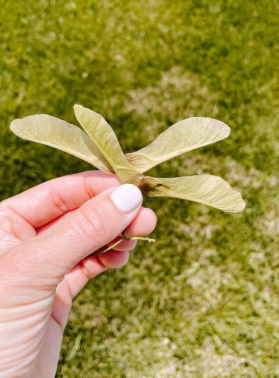
These little maple tree seeds were one of my favorite outdoor play activities when I was a kid. They tend to fall from the trees like “helicopters,” and I would run to try to catch them. Once I did, I would peel them open and stick them on my nose and pretend to be whatever my imagination brought up: Pinocchio, a bird with a long beak, a rhino, etc.
What I didn’t realize then was how much was happening in my body during that simple play.
I was sprinting and stopping quickly (vestibular input).
I was tracking the seed as it spun through the air (visual-motor coordination).
I was bending, grasping, peeling, and manipulating something small and delicate (fine motor skills).
I was tolerating different textures and temperatures (tactile processing).
And I was building imagination, problem-solving, and confidence all at the same time.
Unstructured outdoor play like this boosts confidence, encourages imaginative thinking, and strengthens so many key sensory systems. From vestibular input while running and jumping to tactile exploration with natural materials, outdoor play is a full-body experience.
Did you know that most children spend only 4 to 7 minutes a day in unstructured play outdoors, and over 7 hours a day in front of a screen? Our children’s nervous systems were designed for movement, unpredictability, fresh air, and natural textures. Even short bursts outside can help “reset” the body in ways that improve mood, regulation, and focus later in the day.
Just 10–15 intentional minutes spent outdoors can support your child’s sensory, emotional, and motor development—while also giving space for imagination to expand in ways screens simply cannot offer.
A Gentle Challenge for Families
This week, choose one small way to get outside together.
Catch leaves.
Walk barefoot in the grass.
Climb the jungle gym at the park.
Draw on a sidewalk with chalk.
Watch the clouds float by.
I’d love to hear how your family gets outside this week and what you notice in your child’s body, mood, or creativity afterward!
Reference: childmind.org “Why kids need to spend time in nature.”
Helpful Links
Was this post helpful or did it spark your curiosity? If you’re looking for deeper support, we’ve created a course and curated resources to help families, caregivers, and professionals better understand the motor and regulation challenges many nonspeaking and apraxic autistic individuals experience.
Online Course for Parents, Caregivers & Professionals:
Foundations in Apraxic Autism — an online course exploring the often-missed motor side of autism. Learn how motor planning, nervous system regulation, and the brain-body connection impact communication and daily life, along with practical ways to support the autistic individual in your life.
Explore Our Resource & Service Hub:
Explore our most trusted resources and favorite tools, or discover ongoing support options for families and professionals navigating autism, apraxia, and motor planning differences.
You might also like…